
Why 'Instant' Giveaway Winners Aren't Fair (and How to Spot a Rigged Draw)
An instant winner on a 50,000-comment post means ~99.8% of entrants were never read. Here's why a fair draw takes 20-30 minutes, and the one test that proves your tool is honest: can you download the full entrant list?
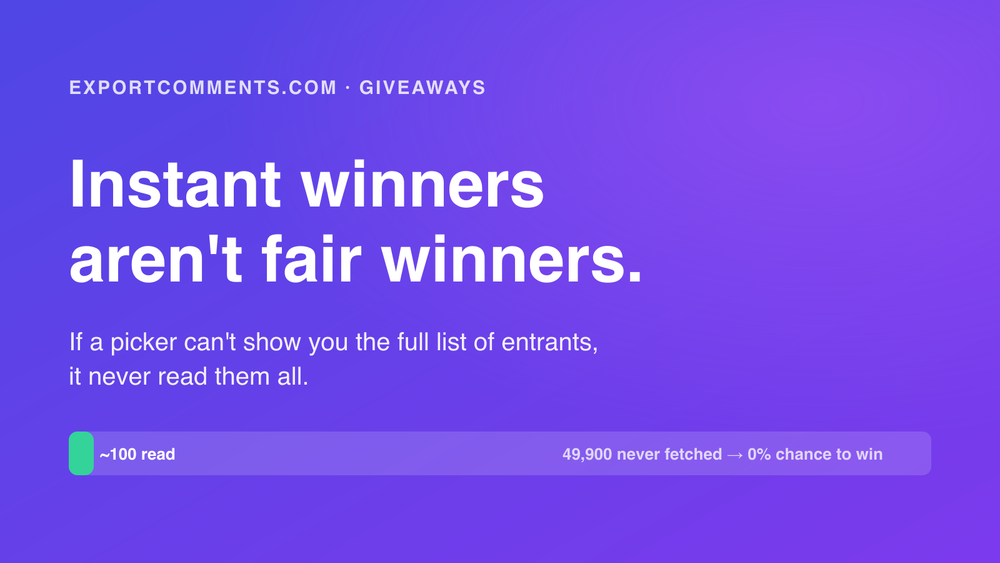
If a giveaway tool hands you a winner the instant you paste a busy post, it didn't read every entry — it read a handful and guessed. Here's how to tell a real, fair draw from a fast one.
The promise that doesn't add up
Picture a post with 50,000 comments. You paste the link into a giveaway picker and… a winner appears in two seconds. It feels great. It's also impossible to do fairly.
To draw fairly, every entrant needs an equal chance — which means the tool has to actually collect all 50,000 comments first. Social platforms don't hand over 50,000 comments in one response. They return them a page at a time (often only a few dozen to ~100 on the first load), and each follow-up page is a separate request. A tool that answers instantly never made those requests. It drew a "winner" from the tiny slice that loaded on the first page and ignored everyone else.
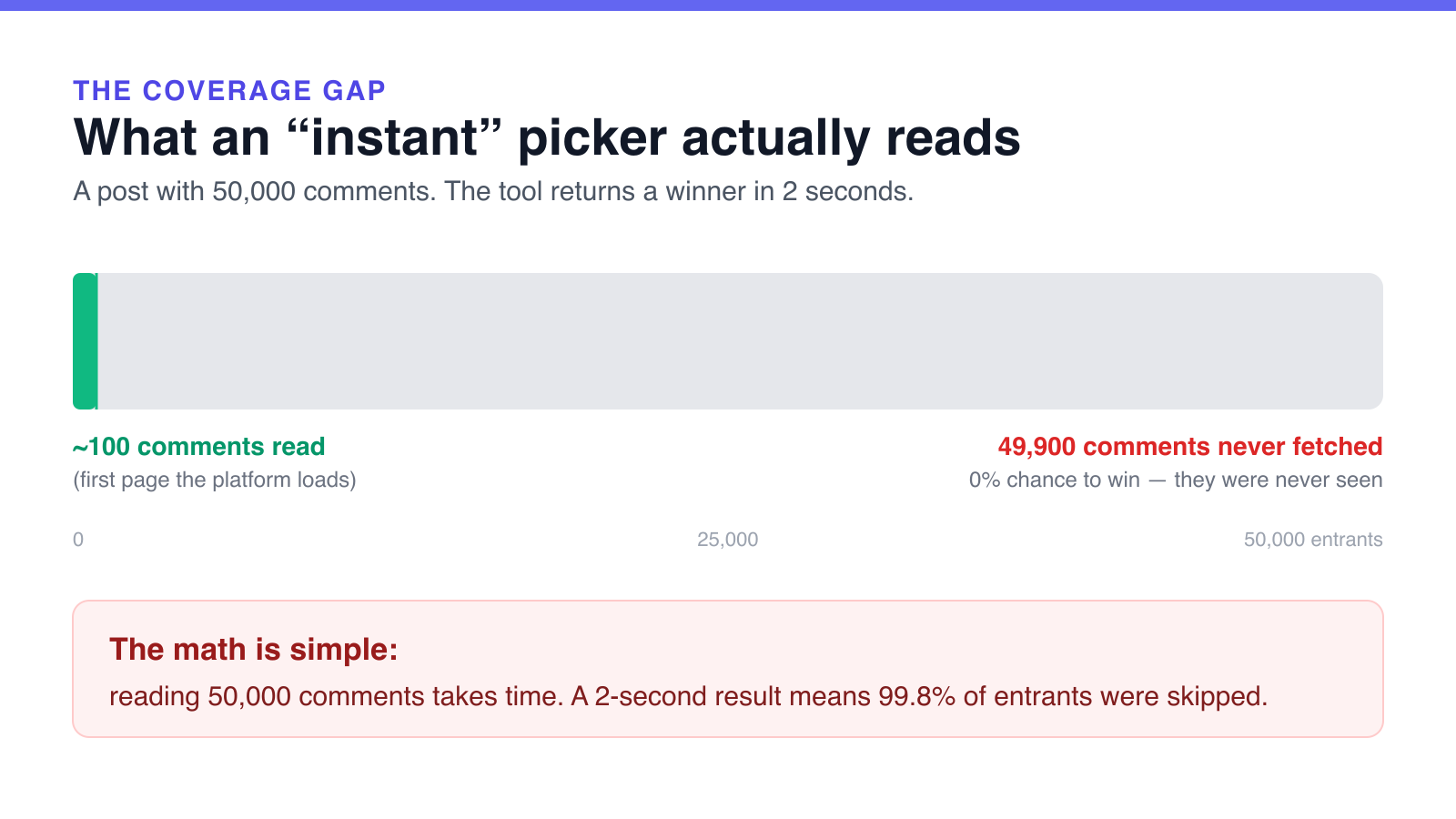
So the draw isn't random across your audience — it's random across whoever happened to comment most recently (or earliest) when the page loaded. Everyone else had a 0% chance, and they'll never know it.
Why a fair draw genuinely takes time
Collecting comments at scale is slow on purpose. Each page is a separate network request, and platforms rate-limit aggressively — fetch too fast and you get blocked, so a proper exporter paces itself with a delay between pages. Multiply ~500 pages by those delays and a large post realistically takes 20–30 minutes (sometimes more) to gather in full.
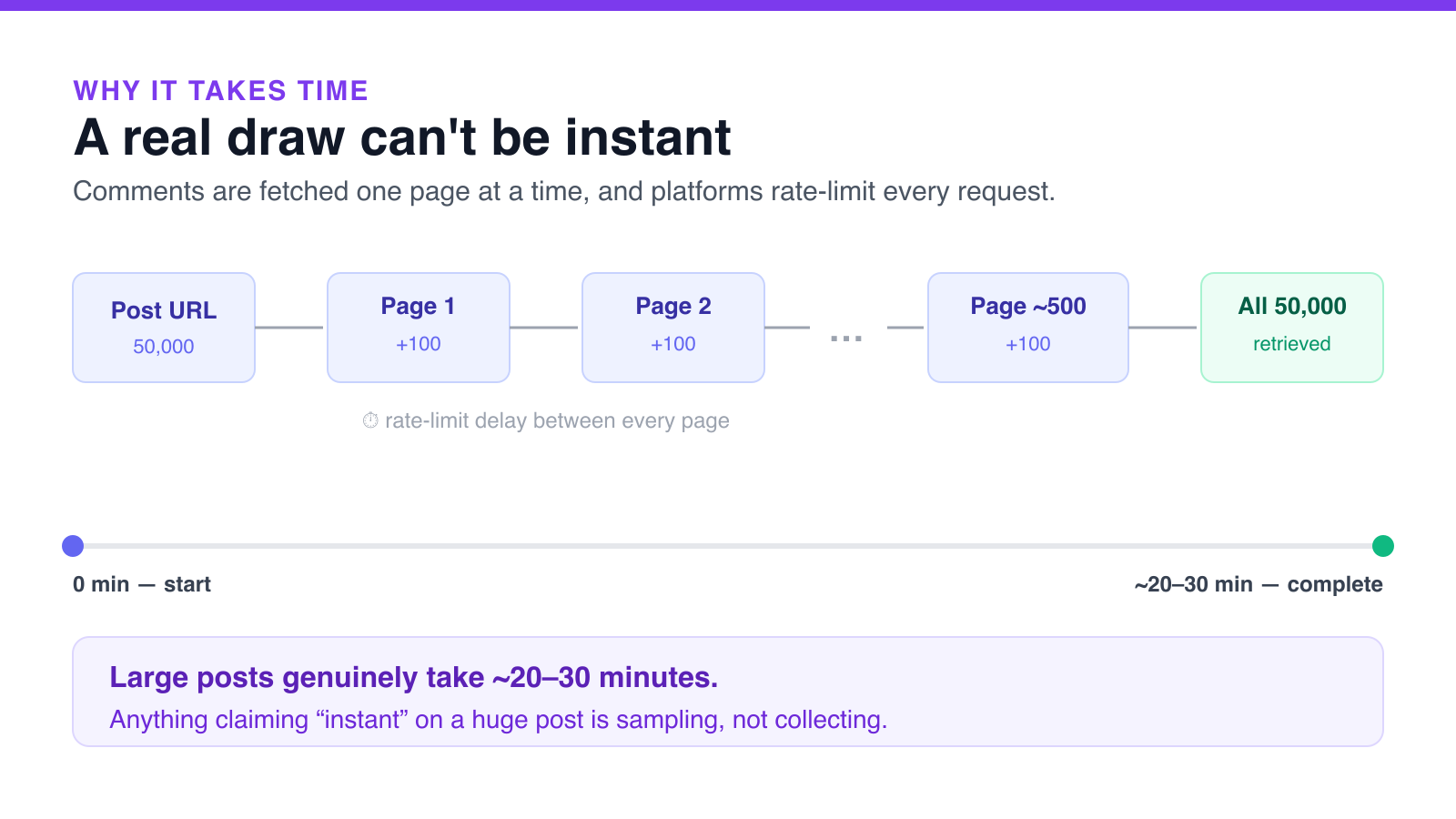
That wait isn't the tool being slow. It's the tool being honest — it's reading every entry so the draw is actually random across all of them. Speed and fairness are a trade-off here, and "instant" wins by skipping the part that makes it fair.
The real tell: can you see the full list?
You don't have to take anyone's word for whether a draw was fair. There's one question that settles it:
Does the tool let you see and download every entrant before it picks?
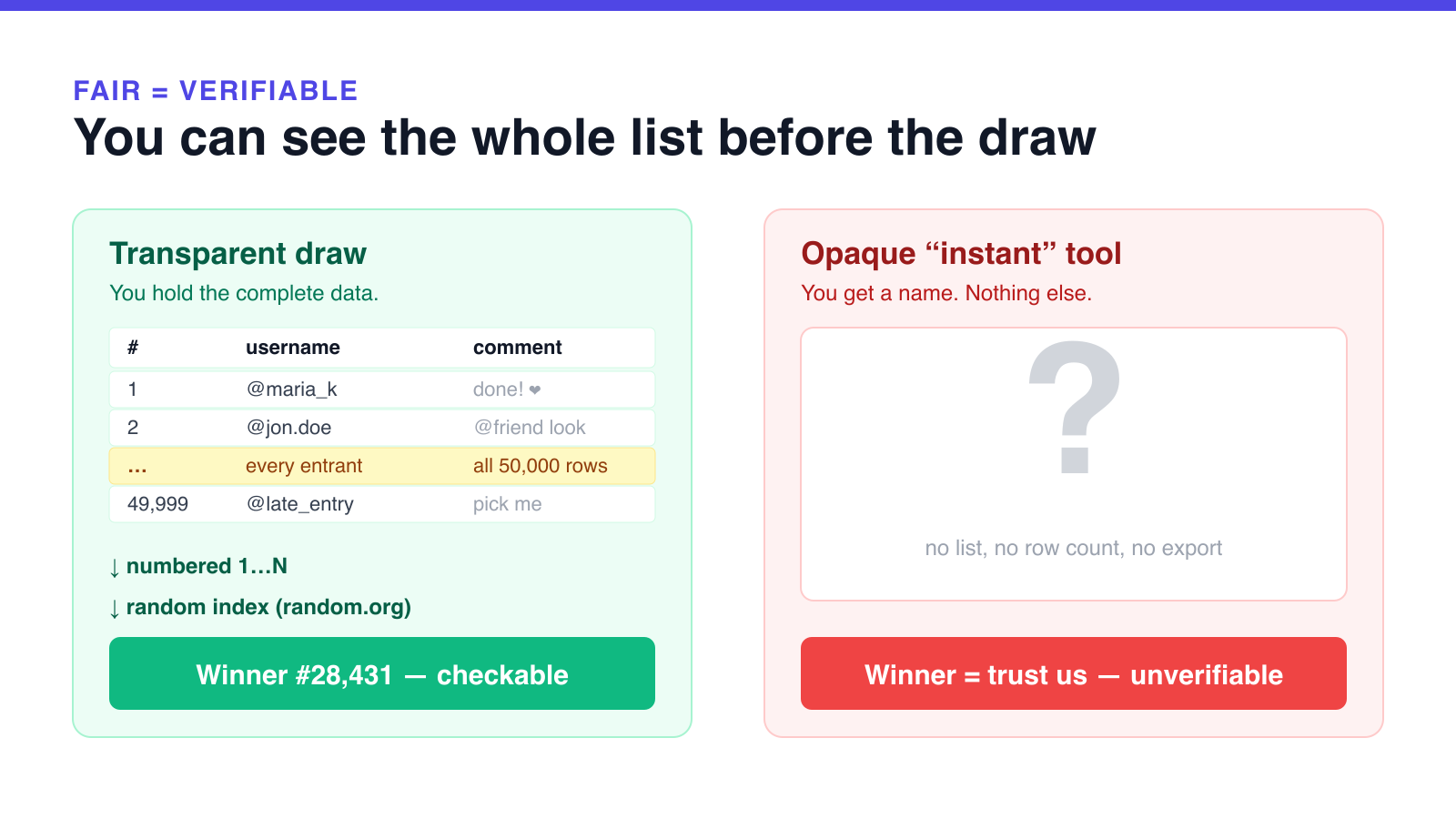
On ExportComments, the draw runs on top of a normal export — so you get the complete entrant list as an Excel/CSV file: every username, comment, timestamp, and likes, for the whole post. You can open it, scroll all 50,000 rows, sort it, de-duplicate it, and confirm the winner's row actually exists in the data before and after the draw. The winner is chosen by a random index over that full numbered list, so anyone can re-check it.
Opaque "instant" tools give you a name and nothing else — no list, no row count, no file to audit. There's no way to confirm the winner came from the full pool, because you were never shown the pool.
A 30-second test for any giveaway tool
- Does it return instantly on a huge post? If yes, it almost certainly sampled the first page instead of collecting everything.
- Can you download the full list of entrants? If there's no Excel/CSV/JSON export, you can't verify the pool.
- Does the entrant count match reality? Compare the tool's number to the comment count shown on the post. A big gap means missing entrants.
- Is the winner reproducible? A fair draw gives you a winner position (e.g. row #28,431) you can look up yourself, not just a name.
- Does it handle replies and "tag-a-friend" comments? Many entries live in replies; a first-page sampler misses them entirely.
How a verifiable draw works on ExportComments
Step 1: Export the whole post
Paste the post URL and start the export. For large posts this is the 20–30 minute step — it's collecting every comment, not a sample. You can close the tab; we email you (and can ping our Telegram bot) when it's done.
Step 2: Open the full entrant list
Download the Excel/CSV and review it. This is the part other tools hide — you literally see everyone who will be in the draw, in one file.
Step 3: Run the draw
Use the free giveaway picker to draw a random winner from the complete, numbered list. Filter for "tag-a-friend" mentions, require a minimum number of tags, or exclude duplicates first if your rules need it.
Step 4: Share the proof
Announce the winner with the row number and the exported file on hand. Anyone who asks "was this rigged?" can be shown the full list and the index. That's a draw you can defend.
New here? Our step-by-step guide to picking a giveaway winner walks through the whole flow.
Plan limits & API access
Export depth scales with your plan: Free 100 / Personal 5,000 / Premium 50,000 / Business 250,000 comments per export. To draw fairly from a 50,000-comment post you need a plan that can actually collect 50,000 — otherwise you're sampling too. See pricing, and automate collection with the REST API on Premium and Business.
FAQ
- Why does my export take 20–30 minutes?
Because it's fetching every comment page-by-page within the platform's rate limits. That wait is what makes the draw fair — every entrant is actually included. - Is an "instant" winner ever legitimate?
On small posts (a few hundred comments) instant can be fine — everything fits in a page or two. On posts with thousands of comments, instant means sampling. - How do I prove my giveaway wasn't rigged?
Keep the exported Excel/CSV of all entrants and announce the winner's row number. The full list plus a random index is auditable by anyone. - Do you count replies and tagged friends?
Yes — replies and "tag-a-friend" mentions are collected, so entries hidden in threads aren't skipped. - What if a post has more comments than my plan allows?
You'd only collect up to your plan's limit, which would itself be a partial pool. Pick a plan that covers the full comment count for a fully fair draw. - Is the random selection truly random?
The winner is chosen by a random index over the complete numbered list, so every collected entrant has an equal chance.